Identify Types of Old Photographs: Daguerreotypes to Polaroids
How to identify old photograph types: daguerreotypes, ambrotypes, tintypes, cartes de visite, cabinet cards, real photo postcards, snapshots and instant prints.
By Ayoub Farid · · 2 min read


Knowing what kind of photograph you're holding helps you date it, handle it safely and decide how to scan and restore it. Here's a field guide to the most common types in family collections.
Daguerreotype (c. 1839–1860)
- Image on a mirror-like silvered copper plate, usually in a small hinged case behind glass.
- Image looks positive or negative depending on viewing angle.
- Extremely delicate: never open the package or touch the surface. Scan or photograph through the glass at an angle that avoids mirror reflections, or ask a professional.
Ambrotype (c. 1854–1865)
- Image on glass with a dark backing, often in a case like a daguerreotype.
- No mirror effect.
- Fragile glass; the dark backing can flake.
Tintype / ferrotype (c. 1856–1900s)
- Image on a thin iron sheet, dark and slightly matte. A magnet sticks to it.
- Often informal portraits, sometimes in paper sleeves.
- Prone to rust, bending and flaking.
Carte de visite (c. 1860–1890s)
- Small paper print (about 2.5 × 4 inches) mounted on card, often with the photographer's name on the back.
- Very popular for collecting and exchanging.
Cabinet card (c. 1870–1920s)
- Larger mounted print (about 4.25 × 6.5 inches) on thick card, often with decorative borders and studio logos.
- Many are sepia-toned (see colorizing sepia photos).
Real photo postcard (c. 1900–1950s)
- A photograph printed on postcard-backed paper, often with a stamp box on the back that can help with dating.
Black and white snapshots (c. 1900s–1960s)
- Small prints from roll film, often with deckled (wavy) edges in the 1940s–1960s.
- The bulk of most family collections.
Color prints (1950s–2000s)
- Early color prints often faded to orange or magenta. Square prints with white borders are typical of the 1960s–70s; "round-corner" prints and silk finishes appear in the 70s–80s. See fixing faded photos.
Instant prints (1960s–today)
- Self-developing prints with a white frame; layers can delaminate. See restoring old Polaroids.
Slides and negatives
- Color slides (positive transparencies) and negatives in strips. See digitizing negatives with your phone.
Why the type matters for restoration
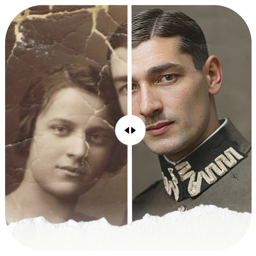
Every type can be digitized and restored. Once you have a good capture, an AI tool such as Refixo can remove cracks, rust spots, stains and fading, sharpen faces and add natural color. The physical object, especially early cased images, should be kept and handled with care (see how to handle old photos).
For dating clues beyond the photo type, read how to date old photos.
Frequently asked questions
How can I tell a tintype from other photos?
Tintypes are on thin metal; a small magnet will stick to them.
What's the difference between a daguerreotype and an ambrotype?
Daguerreotypes are on a mirror-like silvered plate; ambrotypes are on glass with a dark backing and no mirror effect.
Are old cased photos valuable?
Some are, especially early or well-preserved ones. Keep them in their cases and handle gently.
Can very old photo types be restored?
Yes. Capture them carefully, then restore the digital copy.
Restore it in seconds
Bring your old photos back to life
Refixo's AI removes scratches, tears and stains, sharpens faces and colorizes black & white photos in seconds. Free to download on iPhone and iPad, with a 3-day free trial.
Download on theApp Store